
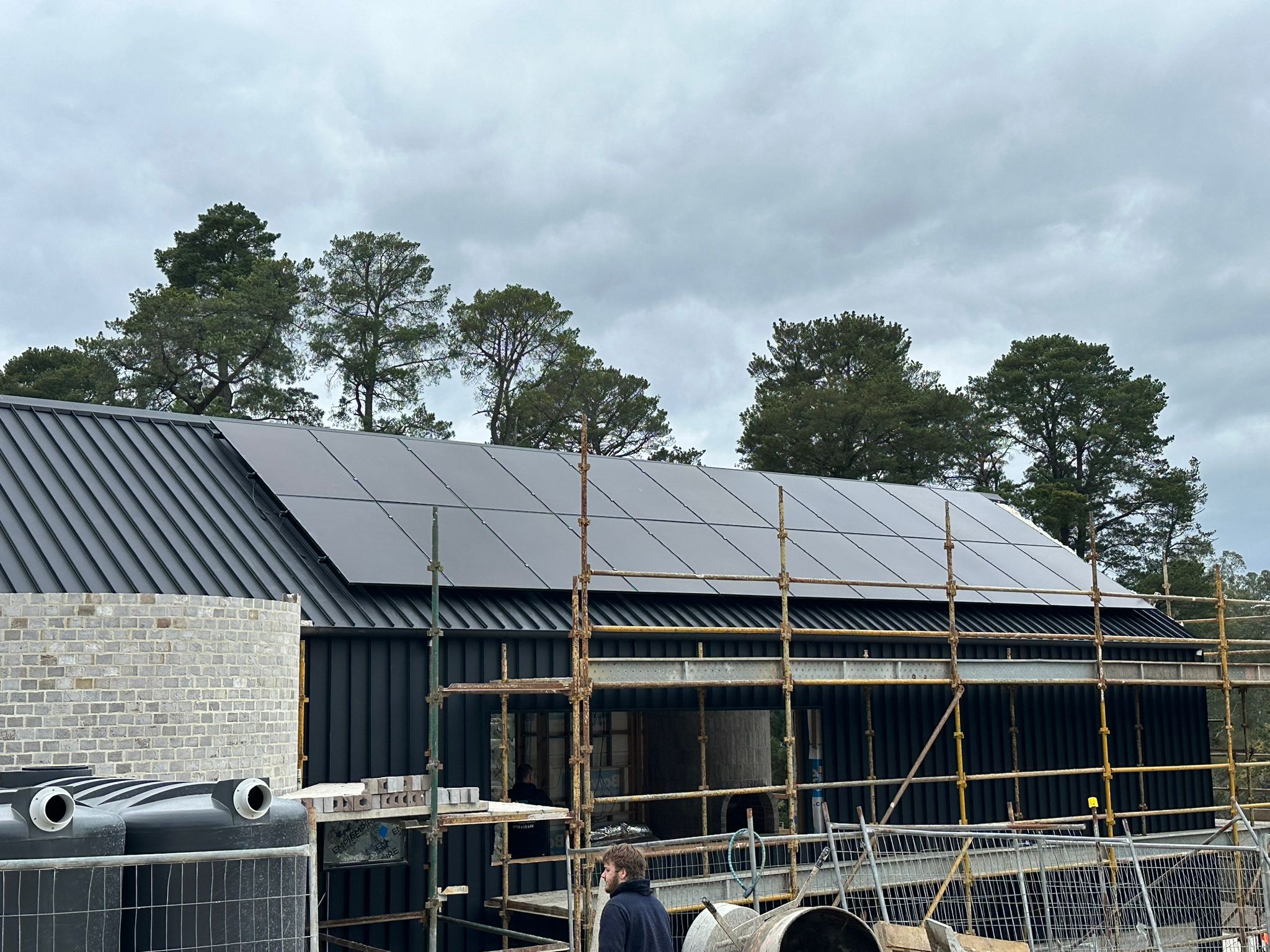
Why the build stage is different
The window you can't reopen
Once your new home is finished, retrofitting solar means drilling through finished ceilings and walls, fishing cables through tight cavities, and paying for labour that should have cost almost nothing at frame stage. We've quoted the same solar system for a completed home at $800–$1,200 more than it would have cost with conduit already in place — and that's before factoring in the mess and the patching.
More importantly, decisions made at build stage — roof pitch, ridge direction, shading from neighbouring lots — are locked in for the life of the house. Getting these right at design stage costs nothing. Fixing them later ranges from expensive to impossible.
Pre-wiring & conduit
Ask your builder about conduit before the frame goes up
Pre-wiring for solar is not the same as installing solar. It means running empty conduit — essentially a plastic sleeve — from your roof space down to your switchboard, so that when you're ready to install panels, the cables have a clear, easy path. Many builders now offer this as an option; few offer it as standard.
What to ask your builder
Conduit
"Can you run 32mm corrugated conduit from the roof space to the switchboard during the rough-in stage?"
This is the key ask. Without it, your installer has to find a path after the fact — often through finished walls, at your expense. Specify 32mm minimum so DC and AC cables can run separately if needed.
Switchboard
"Is the switchboard sized for solar and battery? How many spare breaker slots are there?"
Solar requires a dedicated breaker, and battery adds another. A standard builder-spec board often has zero spare slots, meaning your installer has to replace the whole board — typically $800–$1,500 extra.
Meter box
"Where is the meter box being located, and is there space beside it for a solar inverter?"
Inverters need to be close to the meter box and switchboard. On some builds they end up on the opposite side of the house, adding unnecessary cable run and cost.
EV charging
"Can you also run conduit from the switchboard to the garage for future EV charging?"
If you might ever own an EV, the conduit run to the garage costs almost nothing at build stage. The same run after completion typically costs $400–$900 in cable and labour.
Battery prep
"Is there a dedicated wall space allocated near the switchboard for a future battery system?"
Batteries like Sigenergy or GoodWe systems need floor space or a clear internal wall. Positioning a hot water system or shelving here at build stage can block battery installation later.
What good conduit installation looks like
| Item | Spec to request | Solar-ready? |
|---|---|---|
| Conduit diameter | 32mm corrugated or rigid — separate DC and AC runs | Yes |
| 20mm conduit only | Too narrow for modern cable bundles | No |
| Draw wire installed | A pull-string inside the conduit makes cable installation fast | Yes |
| Conduit ends capped | Prevents insulation, vermin, and moisture entering before install | Yes |
| Spare breaker slots | Minimum 4 spare (solar, battery, EV, future circuit) | Yes |
Roof orientation & pitch
Not all roofs are equal — and your design locks this in
Melbourne sits at approximately 37–38° south latitude. That means solar panels generate the most power when they face true north, tilted at roughly 25–32°. Your builder's default land orientation may not give you a north-facing roof — and it's worth raising before the design is finalised.
Shading: the often-overlooked issue
Even a perfect north-facing roof loses significant output if it's shaded by neighbouring homes, fences, or trees between 9am and 3pm. On a modern housing estate with tight lot sizes, your neighbour's two-storey home to the north is a real concern. Ask your builder to provide a shadow analysis — or check with your solar installer before the design is locked in.
Roof pitch matters too
In Victoria, a roof pitch between 15° and 35° works well for solar. Flat or near-flat roofs (under 5°) require tilt frames, which add cost and change aesthetics. Very steep roofs (above 45°) reduce output in summer but increase it in winter.
Solar Victoria rebate eligibility
Rebate timing for new builds is different — here's what actually applies
The Solar Victoria Solar Panel Rebate (the Solar Homes program) has specific rules for new construction that many buyers — and some builders — don't fully understand. Getting this wrong can mean losing access to a rebate worth up to $1,400.
The timing trap to avoid
- During construction — no rebate available yet. Rebates cannot be claimed for systems installed during construction. A Certificate of Occupancy is required first.
- Certificate of Occupancy issued — window opens. Once the certificate is received and you move in as the owner-occupier, you can apply.
- Apply before your installer books — rebates are allocated quarterly. Rebates are released in batches. Applications can fill up quickly, especially toward the end of the financial year.
- Installation must happen after approval. You cannot install first and claim later. Approval must be in place before installation begins.
Builder solar packages
Should you take the builder's solar deal?
Many volume builders offer solar as an upgrade or inclusion. Sometimes it's a genuine convenience. Sometimes it's a margin-builder with components you wouldn't choose yourself. Here's how to weigh the trade-offs.
Product quality
"What brand of panels and inverter is included, and what are their warranty terms?"
Builder packages often use entry-level components to keep prices low. Ask for specific model numbers — a quality 6.6kW system performs very differently from a budget one.
Installer accountability
"Who is the actual CEC-accredited electrician doing the installation — your direct employees or subcontractors?"
Builders usually subcontract this work. Knowing who is responsible matters if issues like leaks or faulty installs arise after handover. At xTechs, every install is done by our own in-house A-Grade electricians — no subcontracting, ever.
System sizing
"Can we choose the system size, or is the package a fixed 6.6kW? Can we add battery at handover?"
6.6kW suits a 2-person household. Larger families or EV owners may need 10kW+. Builder packages are often not customisable.
If your builder can't give clear answers, ask for a credit and arrange solar yourself after handover. You'll typically get better product choice, proper rebate processing, and an installer accountable to you — not to the builder's margin.
Pre-construction checklist
Your pre-construction solar checklist
Take this to your pre-construction appointment with your builder.
- Roof design: Confirm main roof face orientation is as close to true north as possible. Check ridge direction on the site plan — raise this early when changes are low-cost.
- Conduit: Request 32mm conduit from roof space to switchboard (with draw wire) before rough-in electrical stage.
- Switchboard: Specify minimum 4 spare breaker slots for solar, battery, and EV. Upgrading during the build is far cheaper than replacing the board after handover.
- EV conduit: Run 20–32mm conduit from switchboard to garage for future EV charger — even if you have no current plans.
- Battery space: Reserve wall space near switchboard for a future battery (min. 600mm × 1,200mm). Don't let shelving, hot water, or meter boxes block this area.
- Rebate plan: Don't arrange solar until after Certificate of Occupancy — then apply through a CEC-accredited installer. Check current income cap with Solar Victoria before applying.
Published June 2026 · xTechs Renewables Pty Ltd · ABN 30 673 983 572 · REC 36065 · CEC Accredited
Serving Melbourne, Geelong, Mornington Peninsula & Regional Victoria
About xTechs Renewables: CEC-accredited solar and battery installer serving Melbourne, Geelong, Mornington Peninsula, and regional Victoria. All installations carried out by our in-house A-Grade electricians — we do not subcontract.
*This article is for general information purposes. Solar Victoria rebate eligibility conditions, income thresholds, and program availability are subject to change. Always check solar.vic.gov.au for current program details before applying. See our builders solar page and rebates hub for more.
Building in Melbourne or regional Victoria?
Talk to our team before your pre-construction appointment. We'll review your house plans and tell you exactly what to request from your builder — at no cost.
CEC Accredited · REC 36065 · In-house A-Grade electricians · No subcontracting · Melbourne & surrounds
Guide for Victorian new home buyers and owner-builders. See our solar for builders page and rebates hub for STCs, Solar Victoria, and installation options.